
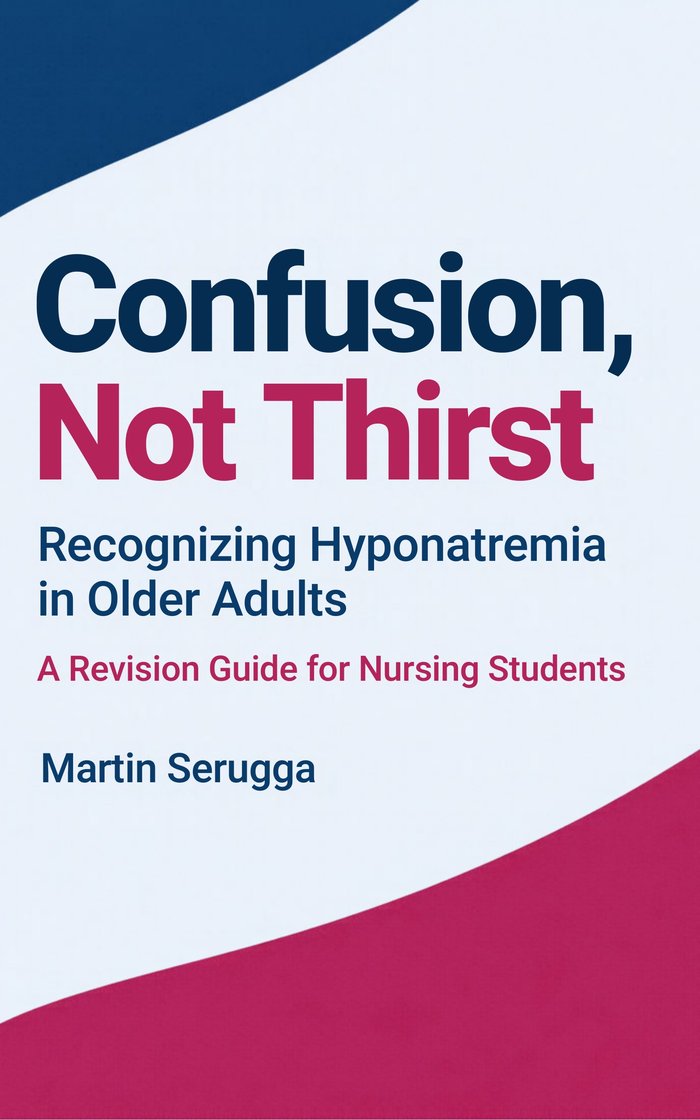
Confusion,
not thirst.
At a sodium of 122 mEq/L, the brain is where the trouble shows. The nurse's job is to recognize it and keep the client safe.
| Finding | Value | What it means |
|---|---|---|
| ↓ | Sodium 122 | Expected range 136–145 mEq/L |
| ↑ | Body water | Dilutes the sodium |
| ! | Confusion | Brain cells swell |
| ! | Fall risk | Gait and attention impaired |
The mistake this guide fixes
Low sodium shows up in the brain, not as thirst.
What students assume
- Low sodium makes the client thirsty
- The client needs more fluids
- New confusion in an older adult means dementia
- A sodium of 122 can be watched
What happens in hyponatremia
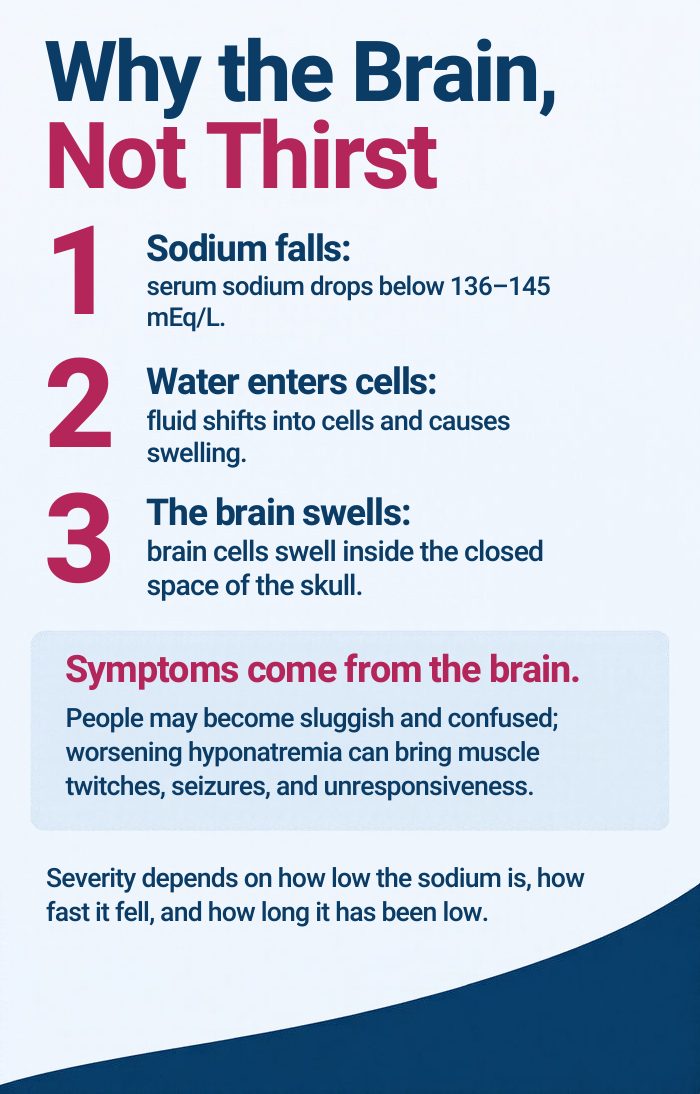
- There is usually too much water, not too little salt
- Water shifts into cells, and brain cells swell
- Confusion and lethargy are the expected findings
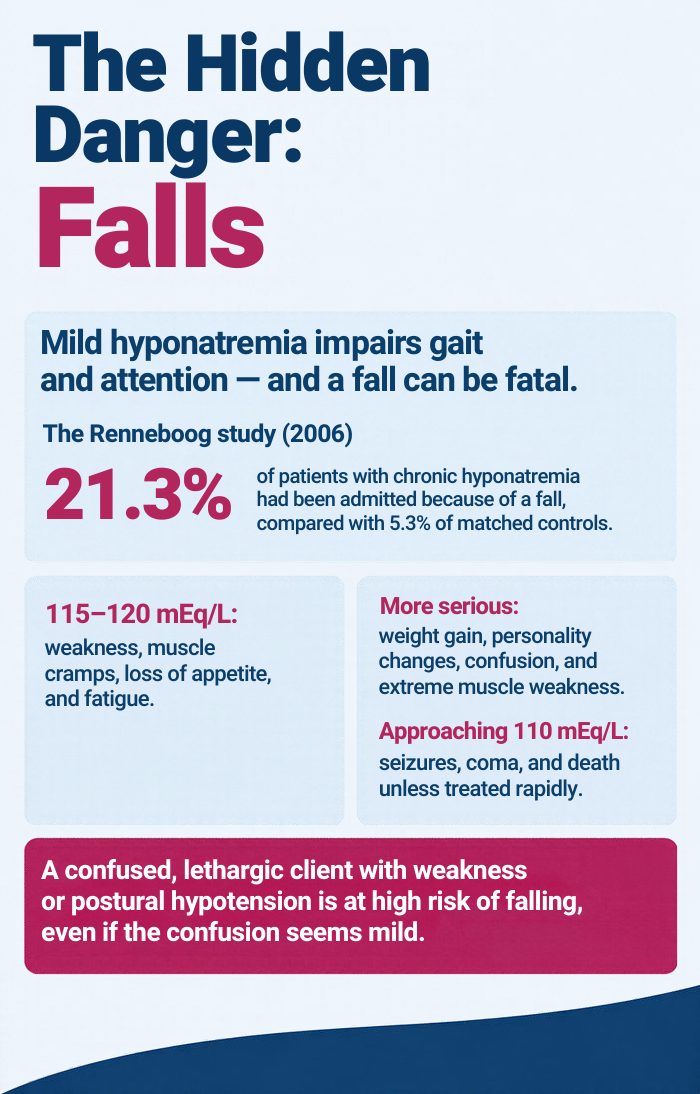
- Unsteadiness and confusion raise the risk of falls
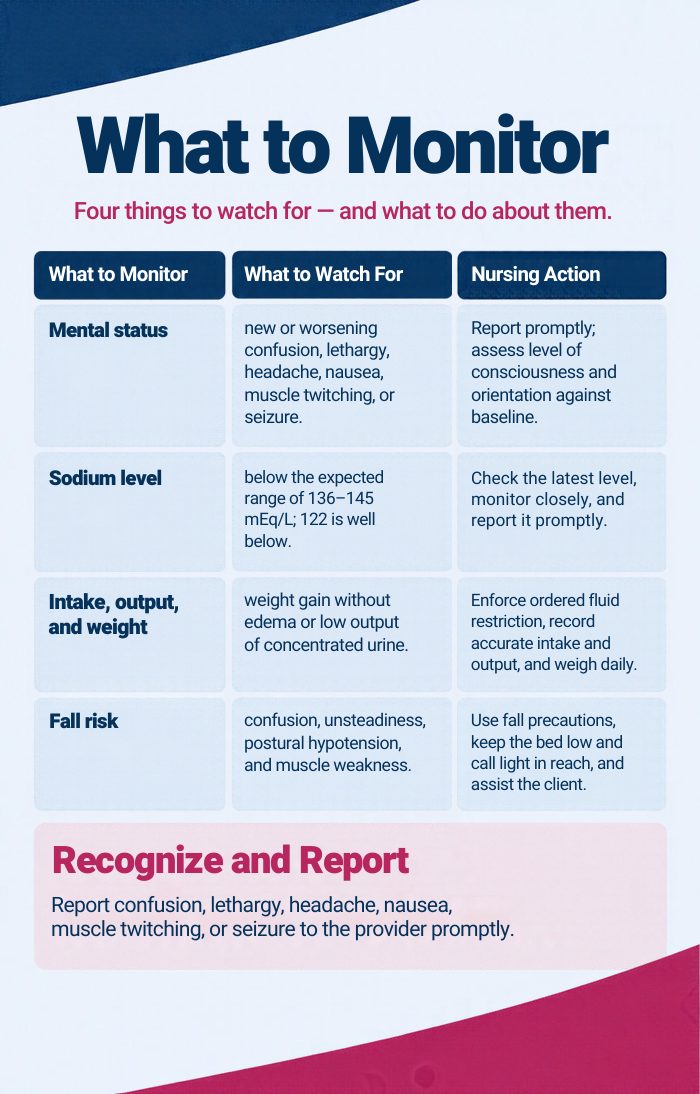
That is why the nurse assesses mental status against baseline, uses fall and seizure precautions, follows any ordered fluid restriction, and expects sodium to be corrected slowly.
What's inside
Eleven parts. Twenty-two pages.
Start with the one-page overview, or follow the three-day reading plan inside the guide.
- The Argument at a GlanceWhat a sodium of 122 means, and what it does not.
- The Scope of the ProblemWhy older adults are at risk.
- Why the Brain, Not ThirstHow water shifts into cells and the brain swells.
- The Hidden Danger: FallsThe evidence behind the fall risk.
- What to MonitorMental status, sodium, intake and output, weight and fall risk.
- Anticipate vs. the TrapsFour findings to expect, and four mistakes to avoid.
- The Full ArgumentThe complete essay, with sources.
- Practice Questions10 exam-style questions to test your understanding.
- Rapid RecallFive reminders and the key numbers.
- Summary TableWhat hyponatremia does, and what the nurse does.
- ReferencesEvery source in APA 7 format.
Look inside
See the pages before you buy.
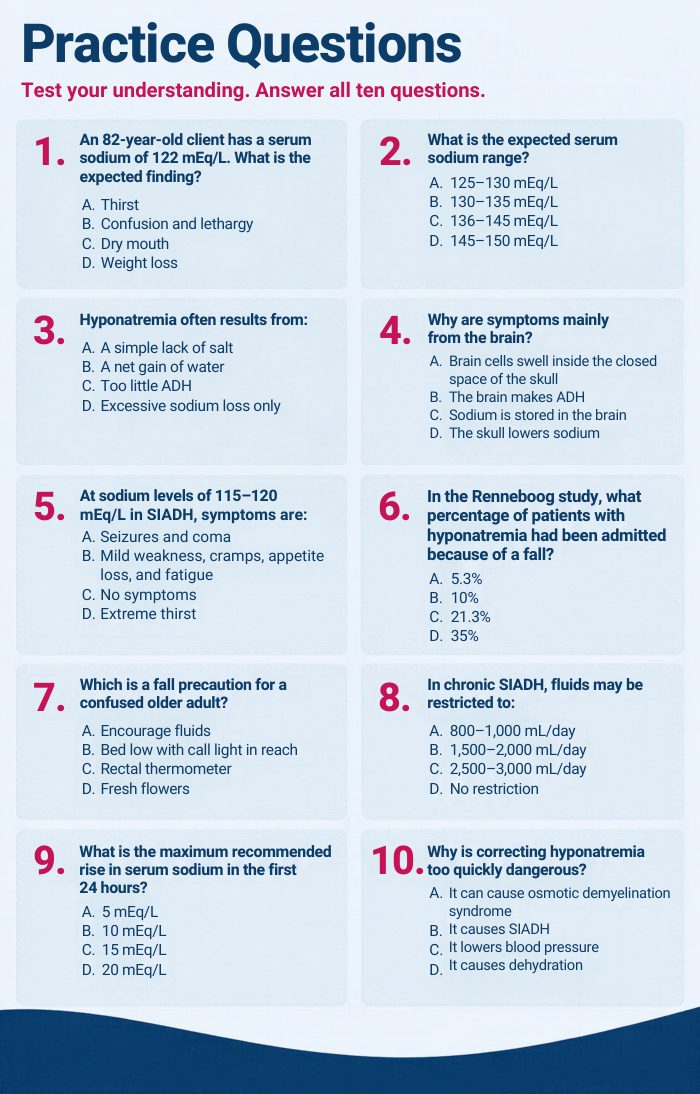
Try a question from the book
Would you pass this one?
An 82-year-old client has a serum sodium of 122 mEq/L. What is the expected finding?
The guide has 9 more questions like this. Get all 10 for $2.99
Who it's for
Written by a nursing student, for nursing students.
LPN and RN students
Studying fluids and electrolytes, older adult care and safety, and wanting the reasoning behind each nursing action.
Exam candidates
Electrolyte questions reward knowing where the symptoms come from, and which finding to report first.
Before clinicals
A quick refresher before caring for an older adult with new confusion or a low sodium result.
Get the guide
Less than a coffee. Ready in seconds.
22-page PDF in portrait format, or a reflowable EPUB that adjusts to any screen. Payments are handled securely by each store.
Questions
Before you buy
What format is it?
The PDF edition is 22 pages and opens on any phone, tablet or computer. The EPUB edition reflows to fit your screen.
What is it based on?
ATI review modules (Adult Medical Surgical, Fundamentals and Pharmacology), Saunders Comprehensive Review for the NCLEX-PN (9th ed.), Memmler's The Human Body in Health and Disease, a 2022 JAMA review of hyponatremia, the Merck Manual and the Renneboog fall study. Every source is listed in APA 7 format.
Do I need the other guides?
No. Each guide stands on its own. Contact, Not Respiratory covers C. difficile, Antibodies Up, Complement Down covers lab values in lupus, Inflammation, Not Fever covers aspirin in rheumatoid arthritis, and More Cells, Less Protection covers infection risk in CLL.
Can I use it for clinical decisions?
No. It is a study aid for nursing students, not a substitute for your facility's policies, your drug reference or professional clinical judgment.
Also in the series
Contact, Not Respiratory: why a client with C. difficile needs gown, gloves and soap and water, not a mask. Antibodies Up, Complement Down: which lab values rise and which fall in lupus. Inflammation, Not Fever: why aspirin is ordered for rheumatoid arthritis. More Cells, Less Protection: why a client with CLL is at risk of infection. See all guides