
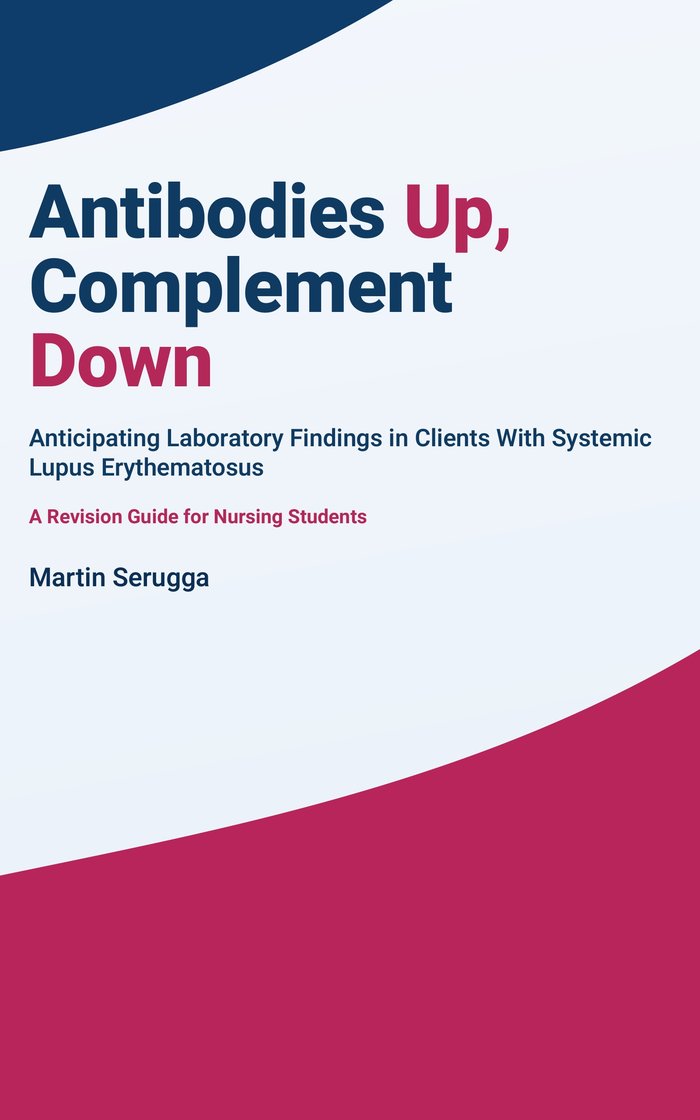
Antibodies up.
Complement down.
Lupus is autoimmunity, not infection, so its lab values move in opposite directions. Learn which ones rise, which ones fall, and why.
| Flag | Test | Why |
|---|---|---|
| ↑ H | ANA titer | Autoantibodies to cell nuclei |
| ↑ H | Urine protein, BUN | Immune complexes injure the kidneys |
| ↓ L | C3 and C4 | Complement is used up |
| ↓ L | WBC count | Antibodies destroy white cells |
The mistake this guide fixes
An overactive immune system doesn't raise every number.
What students predict
- A high white blood cell count, as in infection
- Rising C3 and C4, as in inflammation
- A low white count read as reassuring
- A positive ANA treated as proof of lupus on its own
What SLE actually shows
- Positive ANA, at least 1:80, in nearly every client
- Proteinuria and a rising BUN when the kidneys are involved
- Low C3 and C4 as complement is consumed
- Leukopenia, anemia and low platelets
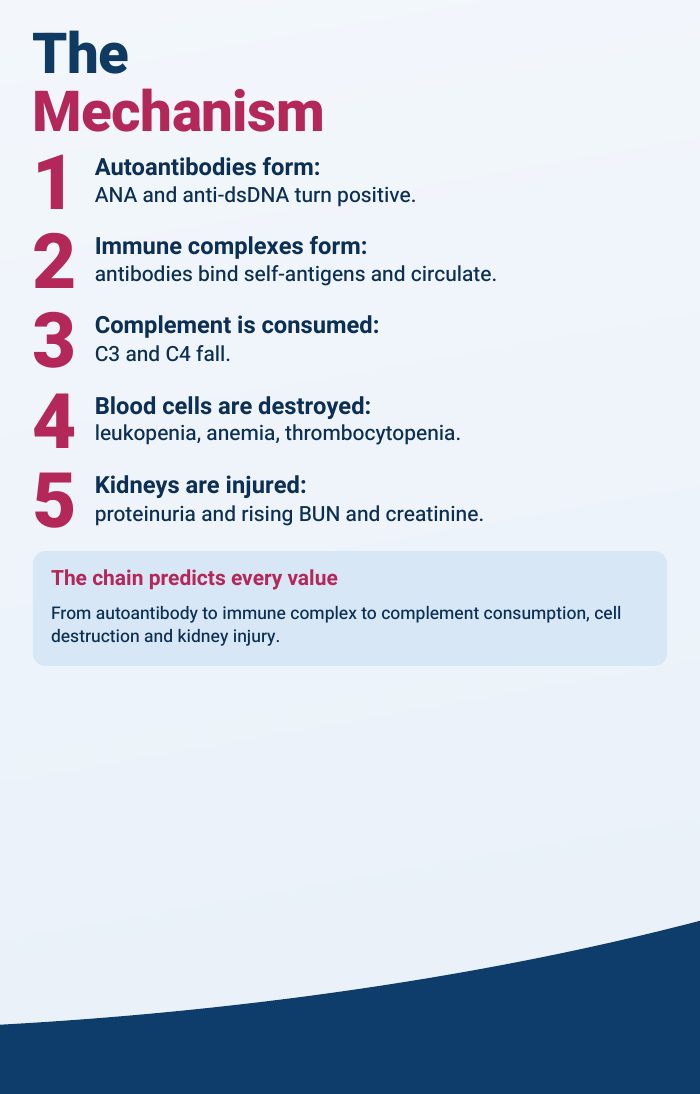
Follow this chain and you can predict the direction of every value on the report. About 10% of clients with lupus nephritis progress to kidney failure, which is why urine protein is screened at least every 6 to 12 months.
What's inside
Eleven parts. Eighteen pages.
Start with the one-page overview, or follow the three-day reading plan inside the guide.
- The Argument at a GlanceThe lab pattern that looks contradictory, and why it makes sense.
- The Scope of the ProblemWhy lupus nephritis matters, and why it can be silent.
- The MechanismFrom autoantibody to kidney injury, step by step.
- Why the Labs Move ApartWhat goes up, what goes down, and why.
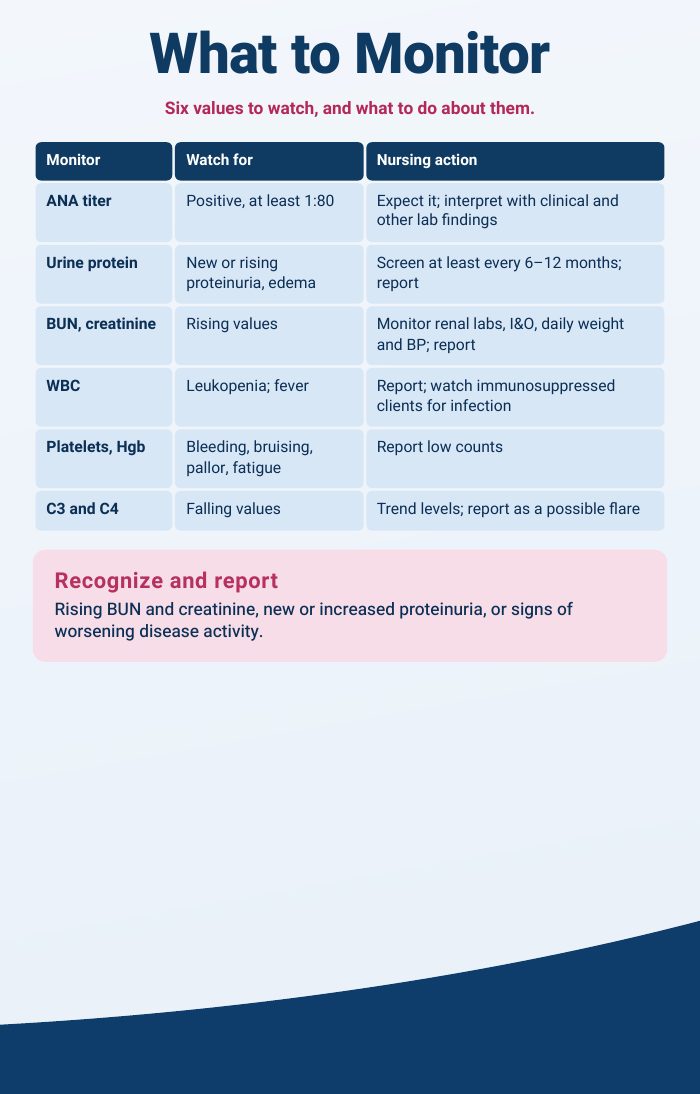
- What to MonitorSix lab values to watch, and what to do about them.
- Anticipate vs. the TrapsThree findings to expect, and the mistakes to avoid.
- The Full ArgumentThe complete evidence-based essay, with sources.
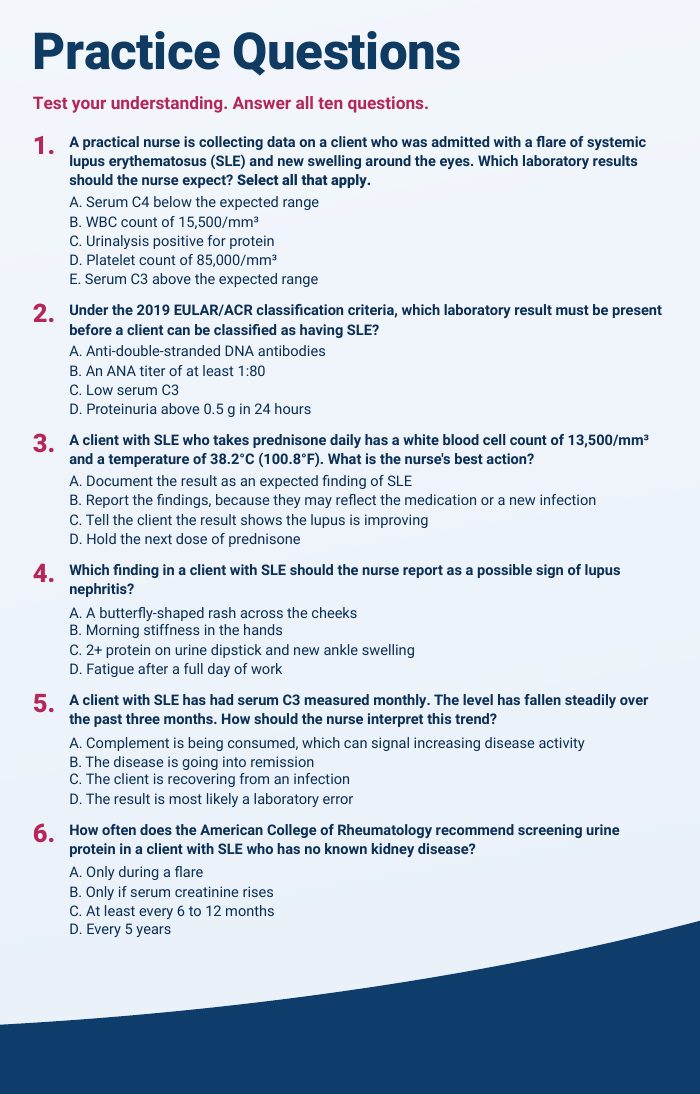
- Practice Questions10 exam-style questions to test your understanding.
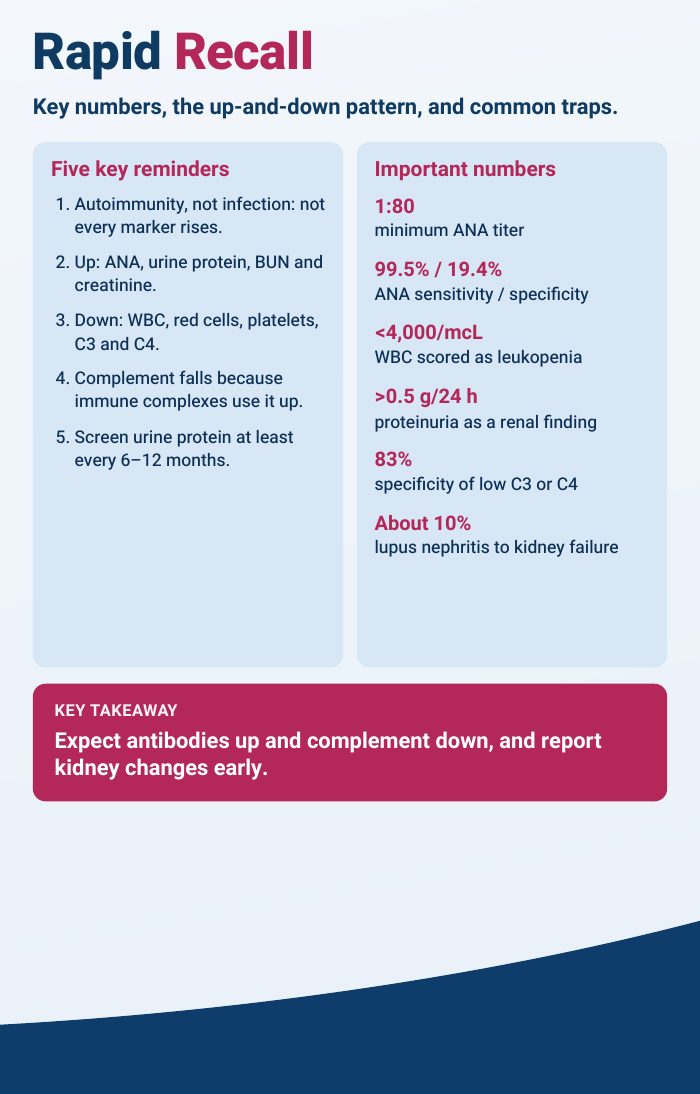
- Rapid RecallFive reminders and the key numbers.
- Summary TableInfection vs. an active SLE flare.
- ReferencesEvery source in APA 7 format.
Look inside
See the pages before you buy.
Try a question from the book
Would you pass this one?
Which statement best explains why serum complement levels fall in active SLE?
The guide has 9 more questions like this,. Get all 10 for $2.99
Who it's for
Written by a nursing student, for nursing students.
LPN and RN students
Studying immune and kidney disorders in med-surg and wanting the reasoning behind each lab value.
Exam candidates
Lab-value questions about SLE are a classic select-all-that-apply trap.
Before clinicals
A quick refresher before caring for a client with lupus or lupus nephritis.
Get the guide
Less than a coffee. Ready in seconds.
18-page PDF in portrait format, or a reflowable Kindle edition that adjusts to any screen. Payments are handled securely by each store.
Questions
Before you buy
What format is it?
The PDF edition is 18 pages and opens on any phone, tablet or computer. The EPUB and Kindle editions reflow to fit your screen.
Is it up to date?
It draws on the 2019 EULAR/ACR classification criteria, the KDIGO 2024 lupus nephritis guideline and the 2024 ACR lupus nephritis guideline.
Do I need the first guide?
No. Each guide stands on its own. Contact, Not Respiratory covers infection control for C. difficile.
Can I use it for clinical decisions?
No. It is a study aid for nursing students, not a substitute for your facility's policies or professional clinical judgment.
Also in the series
Contact, Not Respiratory: why a client with C. difficile needs gown, gloves and soap and water, not a mask. Inflammation, Not Fever: why aspirin is ordered for rheumatoid arthritis. More Cells, Less Protection: why a client with CLL is at risk of infection despite a high white count. Confusion, Not Thirst: why hyponatremia shows up as confusion, not thirst, in older adults. See all guides